博客 How Beekeepers Can Control Late-Summer Varroa Mites Without Compromising Honey Quality
How Beekeepers Can Control Late-Summer Varroa Mites Without Compromising Honey Quality

How Beekeepers Can Control Late-Summer Varroa Mites Without Compromising Honey Quality

1 小时前

Late summer brings a critical challenge for beekeepers: surging Varroa mite populations threaten hive health just as honey supers reach peak production. Balancing effective mite suppression with honey quality preservation requires strategic monitoring, proactive interventions, and community-wide cooperation. This guide delivers actionable solutions tailored for commercial apiaries seeking non-disruptive management approaches.

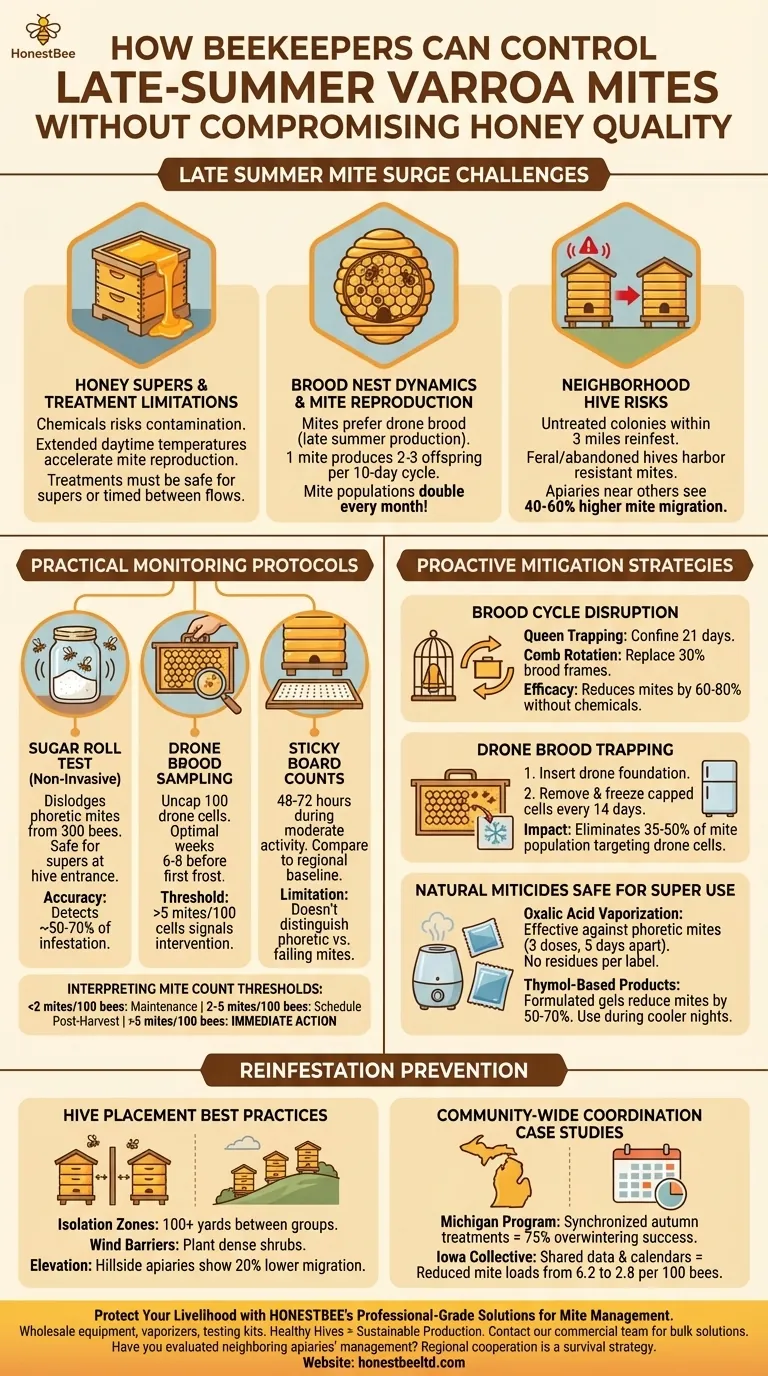
Late Summer Mite Surge Challenges

Varroa destructor populations spike in late summer due to three compounding factors:

Honey Supers and Treatment Limitations

  • Most chemical miticides can't be applied during honey flow due to contamination risks
  • Extended daytime temperatures accelerate mite reproduction cycles
  • Key Consideration: Treatments must be safe for supers or timed between nectar flows

Brood Nest Dynamics and Mite Reproduction

  • Mites preferentially infest drone brood, which colonies still produce in late summer
  • A single mite can produce 2-3 offspring per 10-day worker brood cycle
  • Critical Window: Mite populations double every month during peak season

Neighborhood Hive Risks

  • Untreated colonies within 3 miles act as reinfestation sources
  • Feral hives and abandoned equipment often harbor resistant mites
  • Regional Data: Apiaries near commercial operations see 40-60% higher mite migration rates

Practical Monitoring Protocols

Non-Invasive Sampling Methods During Honey Flow

  1. Sugar Roll Test

    • Uses powdered sugar to dislodge phoretic mites from 300 bees
    • Safe for supers when performed at the hive entrance
    • Accuracy Note: Detects ~50-70% of actual infestation levels
  2. Drone Brood Sampling

    • Uncapping 100 drone cells reveals mite reproduction success
    • Optimal during weeks 6-8 before expected first frost
    • Threshold: >5 mites per 100 cells signals required intervention
  3. Sticky Board Counts

    • Place boards for 48-72 hours during moderate activity periods
    • Compare drops to regional baseline data
    • Limitation: Doesn't differentiate between phoretic and falling mites

Interpreting Mite Count Thresholds

  • <2 mites/100 bees: Maintenance monitoring only
  • 2-5 mites/100 bees: Schedule treatment post-harvest
  • >5 mites/100 bees: Requires immediate brood-targeted action

Proactive Mitigation Strategies

Brood Cycle Disruption Techniques

  • Queen Trapping: Confine queen to 1-2 frames for 21 days to create broodless period
  • Comb Rotation: Replace 30% of brood frames to break mite reproduction cycles
  • Efficacy Data: Disruption methods reduce mite loads by 60-80% without chemicals

Drone Brood Trapping Efficacy

  1. Insert drone foundation in perimeter frames
  2. Remove and freeze capped cells every 14 days
  3. Impact: Eliminates 35-50% of mite population targeting drone cells

Natural Miticides Safe for Super Use

  • Oxalic Acid Vaporization
    • Effective against phoretic mites when applied in 3 doses, 5 days apart
    • Leaves no residues in honey when used per label instructions
  • Thymol-Based Products
    • Formulated gels reduce mites by 50-70% without comb contamination
    • Application Tip: Use during cooler nights to minimize bee irritation

Reinfestation Prevention

Hive Placement Best Practices

  • Isolation Zones: Maintain 100+ yards between treatment groups
  • Wind Barriers: Plant dense shrubs to reduce drifting bees
  • Elevation: Hillside apiaries show 20% lower mite migration rates

Community-Wide Coordination Case Studies

  • Michigan Beekeepers Association Program
    • Synchronized autumn treatments across 8 counties
    • Resulted in 75% overwintering success vs. 45% in non-participating areas
  • Iowa Commercial Apiary Collective
    • Shared monitoring data and treatment calendars
    • Reduced average mite loads from 6.2 to 2.8 per 100 bees in 3 seasons

Protect Your Livelihood with HONESTBEE's Professional-Grade Solutions
Commercial beekeepers trust HONESTBEE's wholesale-focused equipment for mite management that scales. From vaporizers to testing kits, our systems help distributors equip apiaries with research-backed tools—because healthy hives mean sustainable honey production. [Contact our commercial team] for bulk solutions tailored to your operation size.

Have you evaluated how neighboring apiaries' management calendars impact your mite pressure? Regional cooperation isn't just neighborly—it's a survival strategy in modern beekeeping.

图解指南

How Beekeepers Can Control Late-Summer Varroa Mites Without Compromising Honey Quality 图解指南

相关产品

相关文章

相关产品

耐用型 12V 草酸蒸发器,用于治疗蜂巢中的 Varroa 螨虫 养蜂工具

耐用型 12V 草酸蒸发器,用于治疗蜂巢中的 Varroa 螨虫 养蜂工具

耐用的草酸 12V 汽化器可有效控制蜂群中的变螨。安全、快速加热,设计方便用户使用。立即保护您的蜂巢!

Varroa 简易检查螨虫测试套件计数器酒精清洗罐

Varroa 简易检查螨虫测试套件计数器酒精清洗罐

使用 Varroa Easy Check 准确监测 Varroa 螨虫。通过可靠、易用的螨虫检测解决方案确保蜂群健康。

紧凑型圆形蜂螨处理分配器

紧凑型圆形蜂螨处理分配器

紧凑型圆形分配器,用于高效处理蜂螨。可重复使用的通风设计可确保安全、可控的蒸发。是商业养蜂场和业余爱好者的理想选择。

用于治疗蜂蜡螨的 12V 草酸蒸发器

用于治疗蜂蜡螨的 12V 草酸蒸发器

草酸蒸发器专为有效控制瓦氏螨而设计,可促进蜜蜂健康。安全、耐用,养蜂人使用方便。

用于蜂螨处理的可调节甲酸和醋酸分配器

用于蜂螨处理的可调节甲酸和醋酸分配器

专业蜂巢蒸发器,可有效治疗蜂螨。耐用、可重复使用和蜜蜂安全设计,适用于商业养蜂场。使用甲酸或草酸控制瓦氏螨。

用于蜜蜂熏蒸处理的 12V 除螨蒸发器草酸蒸发器 180W 雾化型

用于蜜蜂熏蒸处理的 12V 除螨蒸发器草酸蒸发器 180W 雾化型

高效除螨蒸发器:控制变螨,增强蜂巢健康,提高蜂蜜产量。便携、耐用、使用方便。

用于养蜂的 Langstroth 筛网底板 批发

用于养蜂的 Langstroth 筛网底板 批发

Langstroth 纱窗底板:通过良好的通风、螨虫控制和碎屑管理,增强蜂巢健康。耐用的杉木,可定制尺寸。非常适合 10 框和 8 框蜂巢。

塑料甲虫喷射器诱捕器 养蜂工具和用品

塑料甲虫喷射器诱捕器 养蜂工具和用品

使用塑料甲虫喷射器保护您的蜂巢。可重复使用、环保,能有效防治蜂巢小甲虫。确保蜜蜂健康和蜂蜜丰产。

可重复使用的蜂巢用透明小甲虫诱捕器 甲虫诱捕工具

可重复使用的蜂巢用透明小甲虫诱捕器 甲虫诱捕工具

使用透明小蜂甲虫诱捕器保护您的蜂箱。耐用、可重复使用、不含化学物质。安装简单,有效控制甲虫。是可持续养蜂的理想选择。

用于清除蜜蜂的商用级立式电动扫蜂机

用于清除蜜蜂的商用级立式电动扫蜂机

使用我们的立式电动扫蜂机提高采蜜效率--轻便、快速,专为商业养蜂场设计。不锈钢、便携、高投资回报率。

葫芦形悬挂式黄蜂诱捕器 专业黄蜂捕捉器

葫芦形悬挂式黄蜂诱捕器 专业黄蜂捕捉器

用我们可重复使用的葫芦形黄蜂诱捕器保护养蜂场和农作物。耐用、有效、环保的害虫控制。


留下您的留言