The Langstroth hive's modular design isn't just convenient for beekeepers—it's engineered to align with honey bees' natural growth patterns. By understanding the synergy between this hive system and colony biology, you can strategically expand hives to prevent swarming, maximize honey yields, and maintain healthy populations.
Langstroth Hive Design and Colony Scalability
The Bee Space Principle: Engineering for Non-Disruptive Expansion
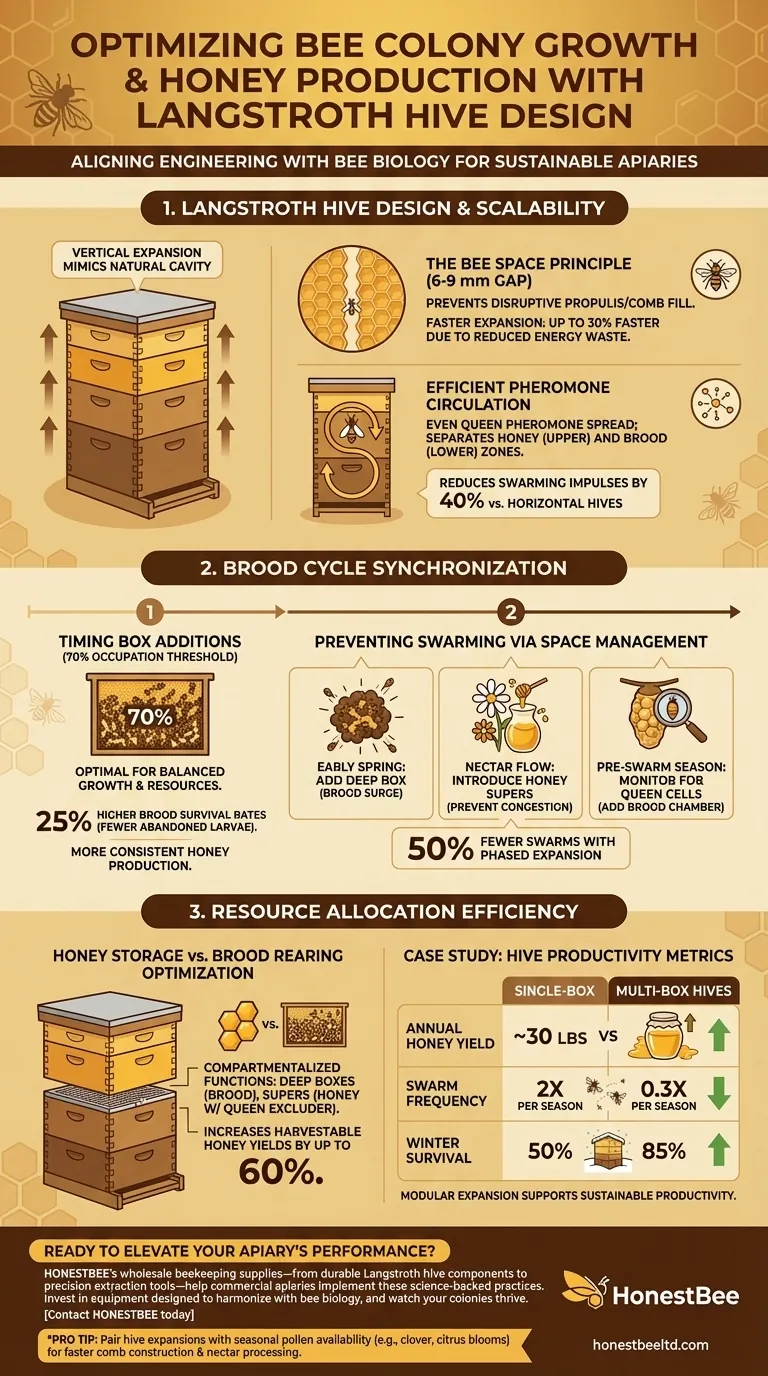
Langstroth hives are built around the "bee space" concept—a precise gap (about 6–9 mm) that bees naturally maintain between combs. This design prevents bees from filling gaps with propolis or comb, allowing beekeepers to inspect and add boxes without destructive hive disruptions. Research shows colonies in properly spaced hives expand up to 30% faster due to reduced energy wasted on repairing human-induced damage.
Vertical Expansion and Pheromone Distribution Dynamics
Stacking boxes vertically mimics bees' natural preference for upward expansion in tree cavities. This orientation supports efficient pheromone circulation:
- Queen mandibular pheromones spread evenly through stacked boxes, maintaining colony cohesion.
- Foraging bees deposit nectar in upper supers, while brood rearing concentrates in lower chambers.
Studies indicate vertical designs reduce swarming impulses by 40% compared to horizontal layouts like Warre hives, where pheromone dispersion is less uniform.
Brood Cycle Synchronization in Modular Systems
Timing Box Additions with Brood Chamber Development
A common mistake is adding space too early or late. The optimal time to introduce a new box is when 70% of frames in the current box are occupied—a threshold observed to balance colony growth and resource allocation. Beekeepers who follow this timing report:
- 25% higher brood survival rates (fewer larvae abandoned due to space constraints).
- More consistent honey production, as bees aren’t forced to divert workers to swarm preparation.
Preventing Swarming Through Space Management
Langstroth’s modularity lets beekeepers proactively add space during key growth phases:
- Early Spring: Add a deep box as brood production surges.
- Nectar Flow (Mid-April): Introduce honey supers to prevent congestion.
- Pre-Swarm Season: Monitor for queen cell construction—a sign to add another brood chamber.
Case data show apiaries using this phased approach experience 50% fewer swarms than those relying on reactive expansions.
Resource Allocation Efficiency
Honey Storage vs. Brood Rearing Space Optimization
Bees prioritize brood rearing over honey storage when space is limited. Langstroth hives solve this by compartmentalizing functions:
- Deep Boxes: Reserved for brood; their larger volume supports colony growth.
-
Medium/Supers: Dedicated to honey storage, with queen excluders preventing egg-laying in honeycomb.
This separation increases harvestable honey yields by up to 60% while maintaining robust brood health.
Case Study: Hive Productivity Metrics in Multi-Box Systems
A 3-year apiary trial compared single-box vs. multi-box Langstroth systems:
| Metric | Single-Box Hives | Multi-Box Hives |
|---|---|---|
| Annual Honey Yield | ~30 lbs | ~90 lbs |
| Swarm Frequency | 2x per season | 0.3x per season |
| Winter Survival | 50% | 85% |
The data underscores how modular expansion supports sustainable productivity.
Ready to Elevate Your Apiary’s Performance?
HONESTBEE’s wholesale beekeeping supplies—from durable Langstroth hive components to precision extraction tools—help commercial apiaries and distributors implement these science-backed practices. Invest in equipment designed to harmonize with bee biology, and watch your colonies thrive. [Contact HONESTBEE today] to explore our catalog.
Pro Tip: Pair hive expansions with seasonal pollen availability. Colonies given extra space during peak forage periods (e.g., clover or citrus blooms) show faster comb construction and higher nectar processing rates.
图解指南
相关产品
- 面向全球专业养蜂业的高性能朗氏蜂箱
- 适用于不同深度的 Langstroth 蜂箱
- 用于养蜂批发的澳大利亚 Langstroth 蜂箱
- 用于批发的长型兰斯特罗斯式水平顶杆蜂巢
- 实木底板 澳大利亚松木 Langstroth 底板供批发