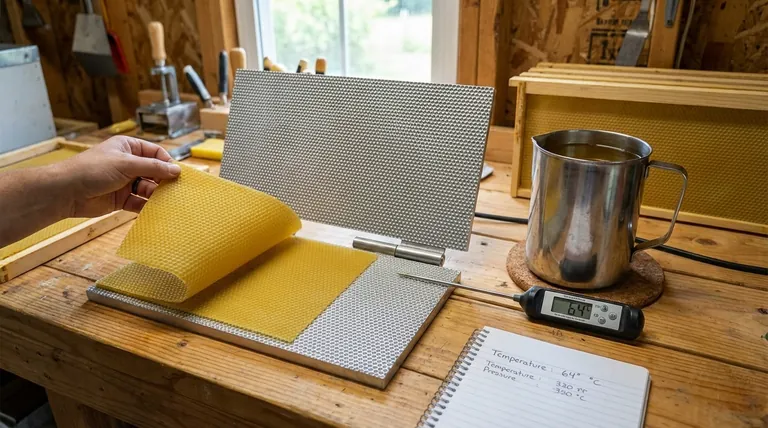
For commercial beekeepers and apiary suppliers, achieving uniform beeswax sheets isn’t just about aesthetics—it’s a science that impacts hive productivity and operational efficiency. This guide demystifies the fluid dynamics and material interactions behind flawless wax distribution in silicone molds, offering actionable insights rooted in thermal physics and surface chemistry.
Beeswax Viscosity Fundamentals
Thermal Thresholds for Optimal Spreadability
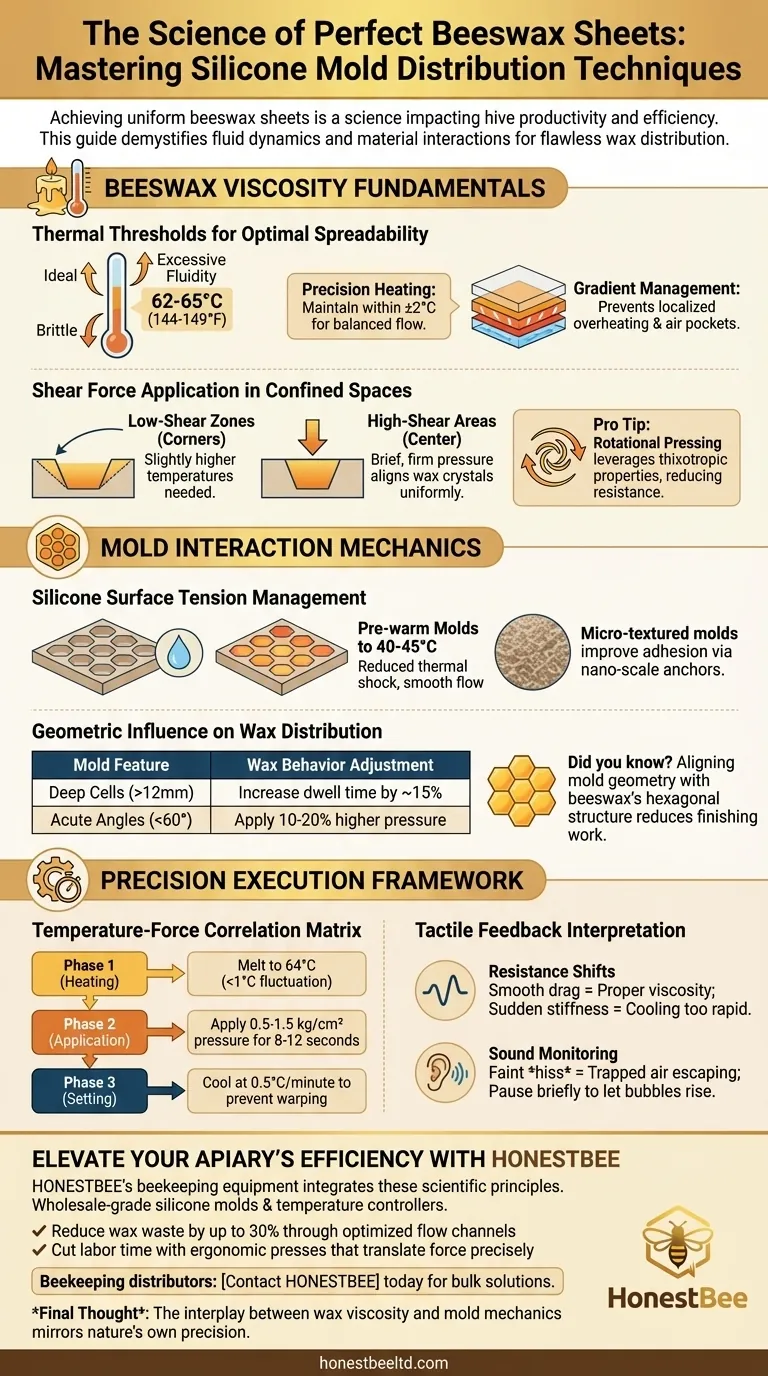
Beeswax transforms between solid and liquid states within a narrow thermal window—typically between 62-65°C (144-149°F). Below this range, wax becomes brittle; above it, excessive fluidity leads to uneven mold filling.
Key considerations:
- Precision heating: Maintain wax within ±2°C of its ideal viscosity point to balance flowability and structural integrity.
- Gradient management: Layer heating (e.g., water jackets) prevents localized overheating that causes air pockets.
Shear Force Application in Confined Spaces
When pressed into silicone molds, beeswax responds to mechanical stress differently than most fluids:
- Low-shear zones (e.g., mold corners) require slightly higher temperatures to compensate for wax’s tendency to stiffen under pressure.
- High-shear areas (center regions) benefit from brief, firm pressure to align wax crystals uniformly.
Pro Tip: Rotational pressing (gentle circular motions) leverages thixotropic properties—reducing wax’s resistance to flow under applied force.
Mold Interaction Mechanics
Silicone Surface Tension Management
Food-grade silicone molds—common in beekeeping—have a non-stick surface energy of ~20-24 mN/m, which repels molten wax unless managed strategically:
- Pre-warming molds to 40-45°C reduces thermal shock, allowing wax to flow smoothly instead of "crawling" away from edges.
- Micro-textured molds (often overlooked) improve adhesion by creating nano-scale anchors for wax molecules.
Geometric Influence on Wax Distribution
Honeycomb cell depth and wall angles introduce fluid dynamics challenges:
| Mold Feature | Wax Behavior Adjustment |
|---|---|
| Deep cells (>12mm) | Increase dwell time by ~15% to allow wax penetration |
| Acute angles (<60°) | Apply 10-20% higher pressure to overcome surface tension |
Did you know? Beeswax naturally forms hexagonal structures—aligning your mold geometry with this innate tendency reduces finishing work.
Precision Execution Framework
Temperature-Force Correlation Matrix
A systematic approach to variable control ensures repeatable results:
- Phase 1 (Heating): Melt wax to 64°C with <1°C fluctuation.
- Phase 2 (Application): Apply 0.5-1.5 kg/cm² pressure for 8-12 seconds.
- Phase 3 (Setting): Cool at 0.5°C/minute to prevent warping.
Tactile Feedback Interpretation
Advanced beekeepers rely on sensory cues:
- Resistance shifts: A "smooth drag" indicates proper viscosity; sudden stiffness suggests cooling is too rapid.
- Sound monitoring: A faint hiss during pressing signals trapped air escaping—pause briefly to let bubbles rise.
Elevate Your Apiary’s Efficiency with HONESTBEE
Why struggle with inconsistent wax sheets when HONESTBEE’s beekeeping equipment integrates these scientific principles into every design? Our wholesale-grade silicone molds and temperature controllers help commercial apiaries:
✔ Reduce wax waste by up to 30% through optimized flow channels
✔ Cut labor time with ergonomic presses that translate force precisely
Beekeeping distributors: Equip your clients with tools that leverage material science for higher yields. [Contact HONESTBEE] today to discuss bulk solutions tailored to large-scale operations.
Final Thought: The interplay between wax viscosity and mold mechanics mirrors nature’s own precision—understanding these hidden variables transforms your wax sheets from functional to exceptional.
图解指南